

Passover Seder Plate Bluenoemi Jewish Table Seder Plate with small dishes
Passover Seder Plate Bluenoemi Jewish Table Seder Plate with small dishes
Authentic Israeli Design
Handmade in Israel
Worldwide Shipping
Gift-ready packaging
✔Secure Checkout
✔ Worldwide shipping
✨ Meaningful gifts from Israel – inspired by the Holy Land✓ Handcrafted with tradition, culture & history✓ A special gift that tells a story
Couldn't load pickup availability
Passover Seder Plate
31 cm
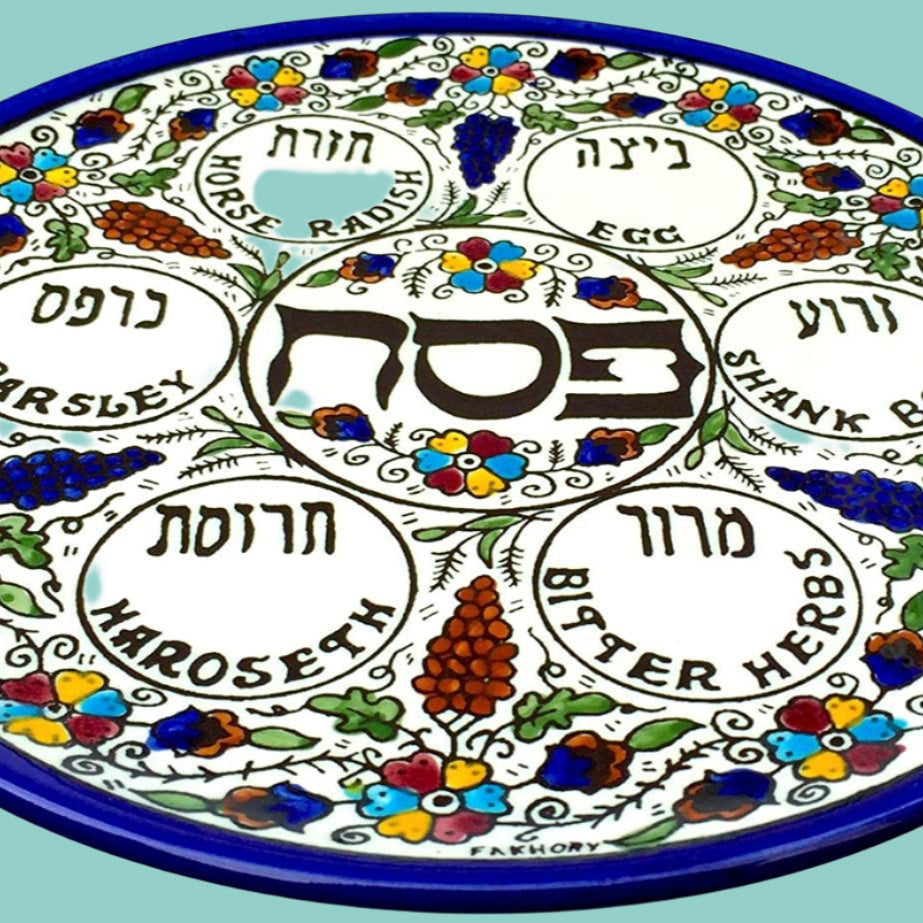
Passover gift plate for decoration and serving on the Passover Table.
Each of the six items arranged on the plate has special significance to the retelling of the story of Passover—the exodus from Egypt—which is the focus of this ritual meal. A seventh symbolic item used during the meal—the three matzos—is not considered part of the seder plate proper.
Symbolic foods

1. Zeroa (shankbone)
2. Beitza (roasted hard-boiled egg)
3. Maror /Chazeret (horseradish)
4. Maror /Chazeret (onion)
5. Charoset
6. Karpas (parsley)
Karpas can be any vegetable for which the blessing over fruit of the earth is recited. Parsley or another green leafy vegetable is traditionally used. Jews of Eastern European descent sometimes use potatoes as it was the closest to a green vegetable that was often available during Passover.
For maror, bitter herbs, use horseradish root or a bitter lettuce. Put enough on the seder plate for everyone as the maror will be eaten during the seder.
The zro'a, shank bone, is a reminder of the Passover sacrifice. According to the Talmud vegetarians may substitute a raw beet, which also bleeds when cut. The zro'a is not eaten at the seder.
The beitzah is a roasted hard-boiled egg. It is included on the seder plate in remembrance of the holiday sacrifice offered at the Temple. It can also be seen as a symbol of creation and the cycle of life and death, as eggs are eaten by mourners after a funeral. The beitzah on the seder plate is not eaten or used during the seder.
The charoset is a mixture of wine, fruits, nuts, honey and spices that symbolizes the mortar with which the Israelites made bricks during slavery. Askenazi charoset is usually made of apples, nuts, sweet wine, honey or sugar and cinnamon. Sephardic charoset recipes contain dates, figs, apricots almonds and less or no wine. Make plenty of charoset, as it is always a favorite.
The sixth optional item on the seder plate is chazeret, a second bitter herb, which is added to the Hillel sandwich. You can use romaine lettuce or prepared horseradish for chazeret.
Let customers speak for us

I purchased the opal stone earrings. Love them. Exactly what I wanted. The customer service was excellent and I’m so happy with this purchase. I will definitely shop with them again!

Very nice

E S P E C T A C U L A R!!!!
Diferente,,bien manufacturado,precioso!
Gracias BLUENOEMI❤️

Increiblemente bello ,una empresa seria y profesional,estoy muy contenta con mi compra.
Dios los bendiga BLUENOEMI y que Dios bendiga a Israel❤️

I had received my ring last week. I tried it on. It looked so royal. I love it every minute.

The stone itself is pretty and the engraving makes it special.

Very nice quality and nice item

This piece is beautiful and I can feel the love coming off of it!

Absolutely beautiful ring. The quality is very high standard, the detail is exquisite .
I ordered a size 9.5 and this size fits my middle finger.
Thank you so much team
I look forward to receiving my next order

I am very keen on the Olefactory - and this blend has just completely delighted the senses!

Love her n her jewelry

Received just as described. Very nice.

Very nice mug, but the one pictured is not the one I got
I got one with camels, which is what I wanted

The earrings and necklace that I bought from BlueNoemi are stunning! They are very stylish and seem to be very good quality. I'm so happy with my purchase! Highly recommend!

beautiful necklace